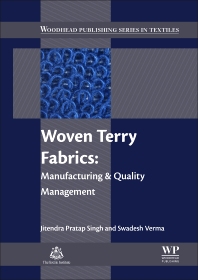
Woven Terry Fabrics Manufacturing and Quality Management
$17.91
$27.58
Description Woven Terry Fabrics: Manufacturing and Quality Management encompasses all aspects of terry fabric production, from raw material choice and weave design to technological developments, dyeing, and quality evaluation. Nothing feels more luxurious and comforting than wrapping myself or one of my children in a thick, soft, fluffy towel after bathing says Lindsey, a healthcare administrator and mother of two children in Boston. Consumers pay an average 15 USD for a bath towel. So, it has become a luxury item today. To meet the demand of growing population, the terry fabric industry has grown to a large extent. Lots of technological developments have taken place in this field. Key Features Provides an excellent overview of the best production methods, quality control systems, latest research, and process parameters Offers in-depth information on all aspects of production Covers comprehensively, for the first time, the whole process from raw material through to finished fabric Includes coverage of technological developments Readership Industry professionals and undergraduate and postgraduate students. Table of Contents 1: Overview of terry fabrics, properties, application and care Abstract 1.1 Introduction 2: Evolution of terry fabrics Abstract 2.1 Definition and history 2.2 Classification of towelling fabrics 2.3 Weft pile fabrics 2.4 Warp pile fabrics 2.5 Different component of terry towel and technical terms 3: Raw materials for terry fabrics Abstract 3.1 Introduction 3.2 Selection of fibre 3.3 Fibre characteristics 3.4 Cotton 3.5 Wool 3.6 Silk 3.7 Summary 4: Yarns for terry fabrics Abstract 4.1 Introduction 4.2 Ring spinning system 4.3 Rotor spinning system 4.4 Air-jet spun yarn 4.5 Friction spun yarn 4.6 Wrap spun yarn 4.7 Yarn structure modifications 4.8 Factors affecting the yarn structure 4.9 Selection of fibres and yarns according to ends use 5: Winding yarn for terry fabrics Abstract 5.1 Introduction and objective 5.2 Different process sequences in the winding section 5.3 Parallel winding machine 5.4 Yarn twisting machine (TFO) 5.5 Rewinding machine 5.6 Tensioners 5.7 Yarns clearer 5.8 Process control in winding 5.9 Process parameters 5.10 Performance in winding 5.11 Control of productivity 6: Warping for terry fabrics Abstract 6.1 Introduction 6.2 Warping 6.3 Warping the terry ground 6.4 Warping the pile warp 6.5 Process control in warping 7: Sizing the terry warp Abstract 7.1 Introduction and objective 7.2 Sizing machine 7.3 Methods of drying 7.4 Splitting 7.5 Beaming 7.6 Prewetting of yarns before sizing 7.7 Quality evaluation of sized yarns 7.8 Sizing materials 7.9 Controls on a modern sizing machine 8: Weaving of terry fabrics Abstract 8.1 Introduction 8.2 Major reference point of the loom 8.3 Process of drawing-in and denting-in 8.4 Terry weaves 8.5 Figured terry pile fabrics 8.6 Important methods for producing woven terry fabrics 8.7 Patterns on terry fabric 8.8 Terms and calculations for woven terry fabric 9: Wet processing Abstract 9.1 Introduction 9.2 Mechanism of dyeing 9.3 Factors affecting dyeing uptake 9.4 Dyeing machines 9.5 Drying 9.6 Colour sensitivity test for human eye 10: Shearing and printing of terry fabrics Abstract 10.1 Introduction and objective 10.2 The shearing machine 10.3 Printing machine 11: Cutting, sewing and packing Abstract 11.1 Introduction 11.2 Stitching 11.3 Thread 11.4 Hemming styles 11.5 Needle 11.6 Manufacturing technology 12: Modern quality management systems Abstract 12.1 Introduction 12.2 Quality systems 12.3 National quality awards 12.4 Quality control in terry towelling manufacturing 12.5 Testing parameters and test methods 12.6 Acceptance sampling for final inspection 13: Properties and performance of woven terry fabrics Abstract 13.1 Introduction 13.2 Absorbency 13.3 Compressibility 13.4 Aesthetic properties 13.5 Air permeability 13.6 Comfort 13.7 Durability and serviceability 14: Hand evaluation of woven terry fabric Abstract 14.1 Introduction 14.2 New primary hand equations BJ-101, BJ-102, BJ-103 and BJ-104 14.3 New total hand equation (BJ-105) 14.4 Contribution of various primary hand equations to the total hand of terry fabric 14.5 Prediction accuracy 14.6 Experimental verification with the test results from regular KES sensor 14.7 Experimental verification with the test results from modified KES sensor (100 mm2) 15: Aesthetic characteristics terry fabrics Abstract 15.1 Introduction 15.2 Texture descriptors 15.3 Uniformity index 15.4 Fractal dimension 15.5 Subjective texture evaluation 15.6 Effect of various fibre, yarn and fabric parameters on surface appearance 16: Compression and surface characteristics of terry fabrics Abstract 16.1 Introduction 16.2 Various parameters affecting the compression and surface characteristics of terry fabrics 17: Absorbency and serviceability of terry fabrics Abstract 17.1 Introduction 17.2 Important variables affecting water absorbency 17.3 Effect of washing cycles on terry fabric properties 17.4 Effect of fabric parameters on after wash performance 18: Producing high-quality terry fabrics Abstract 18.1 Introduction 18.2 Optimisation of loop density, loop length and pile yarn twist for maximum rate of water absorption 18.3 Optimisation of loop shape factor, loop density and loop length for total amount of water absorption 18.4 Optimisation of loop shape factor, loop density and loop length for linearity of compression curve 18.5 Optimisation of loop density, loop shape factor and loop length for compression energy 18.6 Optimisation of loop shape factor, loop density and loop length for compression resilience 19: Troubleshooting in terry fabric production Abstract 19.1 Introduction 19.2 Woven fabric defects and their place of generation at a glance 19.3 Causes and remedial actions for some defects Index