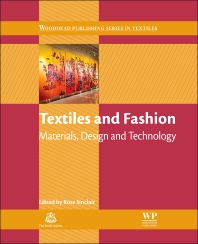
Textiles and Fashion: Materials, Design and Technology
$18.5
$36.82
Description This major textbook is designed for students studying textiles and fashion at higher and undergraduate level, as well as those needing a comprehensive and authoritative overview of textile materials and processes. The first part of the book reviews the main types of natural and synthetic fibres and their properties. Part two provides a systematic review of the key processes involved first in converting fibres into yarns and then transforming yarns into fabrics. Part three discusses the range of range of finishing techniques for fabrics. The final part of the book looks specifically at the transformation of fabric into apparel, from design and manufacture to marketing. With contributions from leading experts in their fields, this major book provides the definitive one-volume guide to textile manufacture. Provides comprehensive coverage of the types and properties of textile fibres to yarn and fabric manufacture, fabric finishing, apparel production and fashion Focused on the needs of college and undergraduate students studying textiles or fashion courses Each chapter ends with a summary to emphasise key points, a comprehensive self-review section, and project ideas are also provided Table of Contents How to Use this Book Part 1. Fibre Types Chapter 1. Understanding Textile Fibres and Their Properties: What is a Textile Fibre? Learning Objectives 1.1. Introduction 1.2. Types of Textile Fibres 1.3. Fibres, Yarns and Fabrics 1.4. Fibre Properties 1.5. Fibre Length, Shape and Diameter 1.6. Fibre Colour and Lustre 1.7. Fibre Fineness 1.8. Fibre Strength, Flexibility and Abrasion Resistance 1.9. Moisture Absorbency 1.10. Electrical Properties of Fibres 1.11. Thermal Properties of Fibres 1.12. Chemical Reactivity and Resistance 1.13. Case Studies: From Fibre Properties to Textile Products 1.14. Summary 1.15. Project Ideas 1.16. Revision Questions Chapter 2. Natural Textile Fibres: Vegetable Fibres Learning Objectives 2.1. Introduction 2.2. Cotton 2.3. Other Seed Fibres 2.4. Bast Fibre 2.5. Other Bast Fibres 2.6. Sustainability Issues/Eco Issues 2.7. Case Studies 2.8. Future Trends 2.9. Summary 2.10. Project Ideas 2.11. Revision Questions Chapter 3. Natural Textile Fibres: Animal and Silk Fibres Learning Objectives 3.1. Introduction 3.2. Wool Fibres 3.3. Silk Fibres 3.4. Other Specialty Hair Fibres 3.5. Applications of Natural Protein Fibres 3.6. Sustainability and Ecological Issues 3.7. Future Trends 3.8. Summary 3.9. Project Ideas 3.10. Revision Questions Chapter 4. Synthetic Textile Fibers: Regenerated Cellulose Fibers Learning Objectives 4.1. Introduction 4.2. Viscose Rayon 4.3. Lyocell Rayon 4.4. Cellulose Acetate 4.5. Applications 4.6. Case Study 4.7. Future Trends 4.8. Summary 4.9. Project Ideas 4.10. Revision Questions Chapter 5. Synthetic Textile Fibres: Polyamide, Polyester and Aramid Fibres Learning Objectives 5.1. Introduction 5.2. Classification of Fibres 5.3. Polyamide Fibres 5.4. Polyester Fibres 5.5. Aramid Fibres 5.6. Blended Fibres: Key Issues 5.7. Case Study: Polyester Fibres for Apparel and Clothing Applications 5.8. Future Trends 5.9. Summary 5.10. Project Ideas 5.11. Revision Questions 5.12. Sources of Further Information and Advice Chapter 6. Synthetic Textile Fibres: Polyolefin, Elastomeric and Acrylic Fibres Learning Objectives 6.1. Introduction 6.2. Polypropylene (PP) Fibres 6.3. Other Polyolefin Fibres 6.4. Acrylic Fibres 6.5. Modacrylic Fibres 6.6. Elastomeric Fibres 6.7. Case Study: Why are There So Many End-Uses for Polypropylene (PP) Fibres, but So Few in Apparel? 6.8. Future Trends 6.9. Summary 6.10. Project Ideas 6.11. Revision Questions 6.12. Sources of Further Information and Advice Chapter 7. Synthetic Textile Fibres: Non-polymer Fibres Learning Objectives 7.1. Introduction 7.2. Carbon Fibres 7.3. Glass Fibres 7.4. Metallic Fibres 7.5. Ceramic Fibres 7.6. Case Study: The Use of CFRP in Sporting Goods 7.7. Future Trends 7.8. Summary Points 7.9. Project Ideas 7.10. Revision Questions Part 2. Manufacturing Textiles: Yarn to Fabric Chapter 8. Conversion of Fibre to Yarn: An Overview Learning Objectives 8.1. Introduction 8.2. Classification of Yarns 8.3. Staple-Fibre Yarns 8.4. Filament Yarns 8.5. Fancy Yarns 8.6. Staple-Fibre Yarn Manufacturing 8.7. Future Trends 8.8. Summary 8.9. Project Ideas 8.10. Revision Questions Chapter 9. Fibre to Yarn: Staple-Yarn Spinning Learning Objectives 9.1. Introduction 9.2. Preparation of Cotton and Other Short Staple Fibres 9.3. Preparation of Wool and Other Long Staple Fibres: The Woollen System 9.4. Preparation of Wool and Other Long Staple Fibres: The Worsted System 9.5. Spinning Techniques for Staple Fibres 9.6. Wrap-Spinning Techniques 9.7. Future Trends 9.8. Summary Points 9.9. Project Ideas 9.10. Revision Questions Chapter 10. Fibre to Yarn: Filament Yarn Spinning Learning Objectives 10.1. Introduction 10.2. Fibre-Extrusion Spinning 10.3. Yarn Texturing 10.4. Bulk Continuous Fibre (BCF) Technology 10.5. Properties of CF Yarns 10.6. Adding Functionality to Yarn 10.7. Applications 10.8. Future Trends 10.9. Project Ideas 10.10. Revision Questions Chapter 11. Yarn to Fabric: Weaving Learning Objectives 11.1. Introduction 11.2. Looms 11.3. Making a Warp and Dressing the Loom 11.4. Documentation 11.5. Pattern Drafting 11.6. Weave Structures 11.7. Derivative-Weave Structures 11.8. Starting to Weave 11.9. Designing for Woven Textiles 11.10. Designing for the Jacquard Loom 11.11. Tapestry Weaving 11.12. Case Study: Honeycomb Woven Structures 11.13. Finishing 11.14. Tips for Weaving 11.15. Future Trends 11.16. Summary 11.17. Revision Questions 11.18. Sources of Further Information and Advice Chapter 12. Yarn to Fabric: Knitting Learning Objectives 12.1. Introduction 12.2. Loop Formation 12.3. Knitting Terminology 12.4. Weft-Knitted Structures 12.5. Warp Knitted Structures 12.6. Knitting Developments 12.7. The Impact of Computers in Design and Technology 12.8. Quality Control 12.9. Case Study 12.10. Future Trends 12.11. Summary 12.12. Project Ideas 12.13. Revision Questions 12.14. Sources of Further Information and Advice Chapter 13. Fibre to Fabric: Nonwoven Fabrics Learning Objectives 13.1. Introduction 13.2. Technologies for the Formation of Nonwoven Fabrics 13.3. Characteristics of Nonwoven Fabric Structure and Properties 13.4. Properties and Performance of Nonwoven Fabrics 13.5. Methods for the Evaluation of Nonwoven Fabric Structure, Properties and Performance 13.6. Nonwoven Fabrics and Their Applications 13.7. Nonwoven Fabrics in Fashion 13.8. Future Trends 13.9. Project Ideas 13.10. Revision Questions 13.11. Sources of Further Information Chapter 14. Yarn to Fabric: Specialist Fabric Structures Learning Objectives 14.1. Introduction 14.2. Triaxial Fabrics 14.3. Pile Fabrics 14.4. Knotted Fabrics 14.5. Braided Fabrics 14.6. Three-Dimensional Fabrics And Future Developments 14.7. Summary 14.8. Project Ideas 14.9. Revision Questions Chapter 15. Yarn to Fabric: Intelligent Textiles Learning Objectives 15.1. Introduction 15.2. What Are Intelligent Textiles Used For? 15.3. Case Study: Biomimetics and Intelligent Textiles 15.4. Future Trends 15.5. Summary 15.6. Project Ideas 15.7. Revision Questions 15.8. Sources of Further Information And Advice Part 3. Fabric Finishing and Applications Chapter 16. Fabric Finishing: Joining Fabrics Using Stitched Seams Learning Objectives 16.1. Introduction 16.2. The Stitch 16.3. The Seam 16.4. Sewing Machines 16.5. Seam Quality Problems 16.6. Future Trends 16.7. Summary 16.8. Case Study and Project Idea 16.9. Revision Questions Chapter 17. Joining Fabrics: Fastenings Learning Objectives 17.1. Introduction 17.2. Zips 17.3. Buttons 17.4. Hook-and-Loop FastenERS 17.5. Press Fasteners 17.6. Cords, Ties and Belts 17.7. Hook-and-Eye Fasteners 17.8. Hook-and-Bar Fasteners 17.9. Buckles and Adjustable Fasteners 17.10. Summary 17.11. Project Ideas 17.12. Revision Questions 17.13. Sources of Further Information Chapter 18. Fabric Finishing: Pretreatment/Textile Wet Processing Learning Objectives 18.1. Introduction 18.2. Processing Methods 18.3. Fabric Preparation Processes 18.4. Quality Control in Fabric Preparation 18.5. Environmental Impact and Sustainability of Fabric Preparation 18.6. Research and Future Trends 18.7. Summary 18.8. Case Study 18.9. Project Ideas 18.10. Revision Questions 18.11. Sources of Further Information Chapter 19. Fabric Finishing: Dyeing and Colouring Learning Objectives 19.1. Introduction 19.2. Colour Theory 19.3. Selection of Dyes 19.4. The Dyeing Process 19.5. Classes of Dye for Different Fibre Types 19.6. Strengths and Weaknesses of Natural and Synthetic Dyes 19.7. Ensuring Quality and Effectiveness of Dyeing 19.8. Environmental Impact of Dyeing 19.9. Research and Future Trends 19.10. Summary 19.11. Case Study: Reactive Dyeing of Knitted Cotton Garments 19.12. Project Ideas 19.13. Revision Questions 19.14. Sources of Further Information Chapter 20. Fabric Finishing: Printing Textiles Learning Objectives 20.1. Introduction 20.2. Direct Printing 20.3. Other Printing Techniques 20.4. Traditional Printing Methods 20.5. Screen Printing 20.6. Transfer Printing 20.7. Digital Inkjet Printing 20.8. Impact of CAD/CAM on the Design of Printed Textiles 20.9. Research and Future Trends 20.10. Summary 20.11. Case Study 20.12. Project Ideas 20.13. Revision Questions 20.14. Sources of Further Information and Advice Chapter 21. Applications of Textile Products Learning Objectives 21.1. Introduction 21.2. Apparel 21.3. Furnishing or Interior Textiles, Including Household Products 21.4. Technical Textiles 21.5. Textile Art 21.6. Textile Industry 21.7. Case Study: Traditional Bedouin al Sadu Hand-Woven Products and Contemporary Digital Applications 21.8. Future Trends 21.9. Summary 21.10. Revision Questions 21.11. Sources of Information Chapter 22. Sustainable Textile Production Learning Objectives 22.1. Introduction 22.2. Key Issues in Sustainability 22.3. The Textile Supply Chain 22.4. Assessing the Environmental Impact of the Textile Supply Chain 22.5. Minimising the Environmental Impact of the Textile Supply Chain 22.6. Case Study: Creating Sustainable and Socially Responsible Fashion 22.7. Summary and Project Ideas 22.8. Sources of Further Information and Advice Part 4. Developing Textile Products: The Case of Apparel Chapter 23. Material Culture: Social Change, Culture, Fashion and Textiles in Europe Learning Objectives 23.1. Introduction 23.2. Art and Society 23.3. Politics 23.4. War 23.5. Impact of Culture on Design, Fashion and Textiles 23.6. Definitions of Textile Culture and Fashion Culture: Are They the Same? 23.7. Project Ideas 23.8. Revision Questions 23.9. Further Reading Chapter 24. Fashion and Culture: Global Culture and Fashion Learning Objectives 24.1. Introduction 24.2. Impact of Culture in European and non-European Arenas 24.3. Case Study 24.4. Future Trends 24.5. Summary Points 24.6. Project Ideas 24.7. Revision Questions 24.8. Further Reading Chapter 25. Fashion and the Fashion Industry Learning Objectives 25.1. Introduction 25.2. Emergence, Development and Change in Fashion 25.3. The Standard Fashion-Trend Cycle 25.4. Why Fashion Changes? 25.5. Revision Questions 25.6. Summary Points Magazines/Periodicals Chapter 26. Visual Design Techniques for Fashion Learning Objectives 26.1. Introduction 26.2. Why Consumers Buy New Designs 26.3. Market Research Methods for Identifying Emerging Consumer Needs 26.4. Finding Inspiration 26.5. Aesthetic Qualities in a Good Design 26.6. Design Tools 26.7. Moving from Sample to Production 26.8. Future Trends: Impact of New Technologies/Processes 26.9. Case Study: The Development of a Garment 26.10. Summary 26.11. Project Ideas 26.12. Revision Questions 26.13. Sources of Further Information and Advice Chapter 27. Computer-Aided Design (CAD) and Computer-Aided Manufacturing (CAM) of Apparel and other Textile Products Learning Objectives 27.1. Introduction 27.2. Fashion and Textile Software Programs 27.3. Using CAD to Design Fashion Products 27.4. Other Uses of CAD in Fashion Design 27.5. CAM in Fashion and Textiles 27.6. Case Studies: Fashion Designers Interviewed by Sandra Burke 27.7. Summary Points and Project Ideas 27.8. Revision Questions 27.9. Sources of Further Information and Advice Chapter 28. Adding Functionality to Garments Learning Objectives 28.1. Introduction 28.2. Factors Affecting Garment Function 28.3. Improving Fabric Handle and Tailorability 28.4. Reducing Wrinkling 28.5. Reducing Pilling 28.6. Reducing Bagging 28.7. Improving Fabric and Garment Drape 28.8. Improving Fabric and Garment Durability 28.9. Research and Future Trends 28.10. Summary 28.11. Project Ideas 28.12. Revision Questions Chapter 29. Improving the Comfort of Garments Learning Objectives 29.1. Introduction 29.2. Tactile Comfort 29.3. Thermo-Physiological (Thermal) Comfort 29.4. Measuring Physiological Comfort 29.5. Psychological Comfort 29.6. Improving Waterproofing and Breathability 29.7. Research and Future Trends 29.8. Summary 29.9. Case Study 29.10. Project Ideas 29.11. Revision Questions Chapter 30. The Marketing of Fashion Learning Objectives 30.1. Introduction 30.2. What Is Marketing? 30.3. The Marketing of Fashion 30.4. Targeting a Market 30.5. Branding 30.6. The Traditional Media Channels 30.7. New Technologies as Media Channels 30.8. The Marketing Plan 30.9. Future Trends 30.10. Summary Points 30.11. Project Ideas and Revision Questions 30.12. Sources of Further Information Chapter 31. The Care of Apparel Products 31.1. Introduction 31.2. Wear of Garments 31.3. Stains 31.4. Laundering 31.5. Care Labelling 31.6. Clothing Storage 31.7. Conclusions and Future Trends 31.8. Sources of Further Information 31.9. Summary Points 31.10. Project Ideas 31.11. Revision Questions Glossary Index