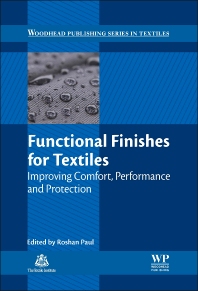
Description Functional finishes for textiles reviews the most important fabric finishes in the textile industry. It discusses finishes designed to improve the comfort and other properties of fabrics, as well as finishes which protect the fabric or the wearer. Each chapter reviews the role of a finish, the mechanisms and chemistry behind the finish, types of finish and their methods of application, application to particular textiles, testing and future trends. Key Features Describes finishes to improve comfort, performance, and protection of fabric or the wearer Examines the mechanisms and chemistry behind different types of finishes and their methods of application, testing and future trends Considers environmental issues concerning functional finishes Readership R&D managers in the textile industry and academic researchers in the area of textiles Table of Contents 1: Functional finishes for textiles: an overview 1.1 Introduction 1.2 Types of functional finishes 1.3 Finishes for improving comfort and performance 1.4 Finishes for protecting wearers and textiles 1.5 Future trends and challenges 1.6 Conclusion Part One: Improving comfort and performance 2: Thermal regulation finishes for textiles 2.1 Introduction 2.2 Mechanisms of thermal regulation in textiles 2.3 Phase change materials (PCMs) for thermal regulation 2.4 Storage of PCMs for thermal regulation 2.5 Supercooling and thermal conductivity 2.6 Application of PCMs and PCM based products to textiles 2.7 Testing the effectiveness of finishes 2.8 Market profile and commercial application areas 2.9 Future trends and challenges 2.10 Conclusion 3: Moisture management and soil release finishes for textiles 3.1 Introduction 3.2 Mechanisms of moisture management and soil release 3.3 Chemistry and application methods 3.4 Testing the effectiveness of finishes 3.5 Future trends and challenges 3.6 Conclusion References 4: Softening finishes for textiles and clothing 4.1 Introduction 4.2 Mechanisms of softening 4.3 Types of softeners and methods of application 4.4 Recent advances in softening finishes 4.5 Application of softening finishes on textiles 4.6 Evaluation of softening finishes 4.7 Future trends and challenges 4.8 Conclusion References 5: Enzymatic biofinishes for synthetic textiles 5.1 Introduction 5.2 Enzymatic biofinishing of polyester fibres 5.3 Enzymatic biofinishing of polyamide fibres 5.4 Enzymatic biofinishing of acrylic fibres 5.5 Future trends 5.6 Conclusion 5.8 Acknowledgements References 6: Commercial shrink-resist finishes for wool 6.1 Introduction 6.2 Dimensional stability of wool products 6.3 Continuous felt-resist treatment of wool 6.4 Batchwise felt-resist treatment of wool 6.5 Quality assurance and accreditation of felt-resist processes 6.6 Blending wool with other fibres 6.7 Future trends 6.8 Conclusion References 7: Easy care finishes for textiles 7.1 Introduction 7.2 Formaldehyde based crosslinking agents 7.3 Low formaldehyde crosslinking agents 7.4 Formaldehyde free crosslinking agents 7.5 Applications of easy care finishes 7.6 Methods to determine easy care behaviour 7.7 Health, safety and environmental aspects 7.8 Future trends 7.9 Conclusion References 8: Self cleaning finishes for textiles 8.1 Introduction 8.2 Superhydrophobicity and self cleaning 8.3 Superhydrophobic structures in nature 8.4 Creating superhydrophobic surfaces on textiles 8.5 Challenges in the development of superhydrophobic surfaces 8.6 Non-textile applications of superhydrophobic surfaces 8.7 Photocatalysis using TiO2 for self cleaning 8.8 TiO2 based self cleaning treatments for textiles 8.9 TiO2 photocatalysis versus superhydrophobicity 8.10 Future trends 8.11 Conclusion 9: Superabsorbent finishes for textiles 9.1 Introduction 9.2 Types of superabsorbent finishes and methods of application 9.3 Superabsorbency mechanisms 9.4 End uses and technical applications 9.5 Testing the effectiveness of superabsorbent finishes 9.6 Future trends and challenges 9.7 Conclusion 9.8 Sources of further information and advice References 10: Medical, cosmetic and odour resistant finishes for textiles 10.1 Introduction 10.2 Different techniques for functionalising textiles 10.3 Advantages and disadvantages of different technologies 10.4 Applications of medical textiles 10.5 Applications of cosmetotextiles 10.6 Applications of odour resistant textiles 10.7 Performance analysis and safety aspects 10.8 Future trends 10.9 Conclusion References Part Two: Protecting wearers and textiles 11: Insect repellent finishes for textiles 11.1 Introduction 11.2 Mechanisms of repellent action 11.3 Types of insect repellent finishes 11.4 Development of insect repellent textiles 11.5 Testing the effectiveness of finishes 11.6 Future trends and challenges 11.7 Conclusion References 12: Antimicrobial finishes for textiles 12.1 Introduction 12.2 Types of antimicrobial finishes 12.3 Methods of application 12.4 Mechanism of antimicrobial finishes 12.5 Evaluation of antimicrobial finishing 12.6 Troubleshooting for antimicrobial finishes 12.7 Future trends and challenges 12.8 Conclusion 12.9 Sources of further information and advice References 13: Hydrophobic and oleophobic finishes for textiles 13.1 Introduction 13.2 Mechanism and chemistry of hydrophobic and oleophobic surfaces 13.3 Hydrophobic and oleophobic textiles 13.4 Overview of testing methods 13.5 Future trends and challenges 13.6 Conclusion 13.7 Acknowledgements References 14: Flame retardant finishes for textiles 14.1 Introduction 14.2 Mode of action of flame retardants 14.3 Developments in flame retardant chemicals 14.4 Flame retardant treatments 14.5 Applications of flame retardant textiles 14.6 Assessing the flame retardancy of textiles 14.7 Regulations for coated textiles 14.8 Future trends and challenges 14.9 Conclusion References 15: Ultraviolet protection finishes for textiles 15.1 Introduction 15.2 Mechanisms of UV protection 15.3 Chemistry and mechanisms of UV protection finishes 15.4 UV protection finishing for various textile structures 15.5 Nanotechnology based UV protection finishing 15.6 Test methods for efficacy of UV protection finishes 15.7 Future trends and challenges 15.8 Conclusion References 16: Radiation protection finishes for textiles 16.1 Introduction 16.2 Electromagnetic radiation: exposure sources and effects 16.3 Shielding mechanism and evaluation of radiation protection 16.4 Types of finishes for ionizing radiation shielding 16.5 Types of finishes for non-ionizing radiation shielding 16.6 Textile finishing durability 16.7 Future trends and challenges 16.8 Conclusion 16.9 Acknowledgements References 17: Antistatic and electrically conductive finishes for textiles 17.1 Introduction 17.2 Electrostatic phenomena 17.3 Electrical resistivity and conductivity 17.4 Theory of electrostatic charge 17.5 Mechanisms of charge dissipation on insulating surfaces 17.6 Effect of static charge 17.7 Electrostatic measurement methods 17.8 Static control in textile fibres 17.9 Antistatic finishing agents and finishes 17.10 Applications of antistatic and electrically conductive textiles 17.11 Future trends and challenges 17.12 Conclusion 17.13 Sources of further information and advice 18: Biological and chemical protective finishes for textiles 18.1 Introduction 18.2 Mechanisms and chemistry of protective finishes 18.3 Types of finishes and application methods 18.4 Challenges involved in textile application 18.5 Testing the safety and effectiveness of finishes 18.6 Future trends and challenges 18.7 Conclusion References 19: Ballistic and impact protection finishes for textiles 19.1 Introduction 19.2 Mechanisms of protection 19.3 Types of protective finishes 19.4 Application of protective finishes and the challenges 19.5 Testing the effectiveness of finishes 19.6 Future trends and challenges 19.7 Conclusion References 20: Environmental and safety issues regarding functional finishes 20.1 Introduction 20.2 Legal demands 20.3 Requirements for cosmetotextiles 20.4 Requirements related to nanotechnologies 20.5 Demands from consumers: ecolabels 20.6 Improving the environmental profile 20.7 Conclusion 20.8 Sources of further information and advice References