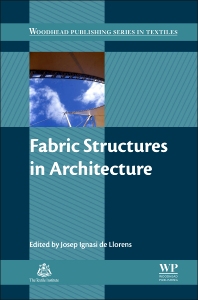
Description Fabric Structures in Architecture covers the varying ways textiles and their properties are used in building construction, with particular focus given to tensile structures. The text begins with the fundamental principles of textiles, including the origins of fabric architecture, then progressing to a discussion of the modern textiles of today. It covers relevant textile materials and their properties, including coatings and membranes. In addition, a range of design considerations are discussed, with detailed information on installation and failure modes. A series of case studies from around the world accompany the discussion, illustrating the applications of textiles in architecture. Key Features Offers key coverage of the fundamental principles, from the origins of fabric architecture to modern textile Provides analysis of relevant textile materials and their properties, including coatings and membranes Contains expert insights in to the applications of textiles in architecture, presenting a series of relevant case-studies from around the world Readership Textile manufacturers, architects, engineers, and postgraduate students and academic researchers in textile science Table of Contents Preface 1. Introduction: the development of fabric structures in architecture 1.1. The characteristics of fabric structures as used in architecture 1.2. Prehistoric and traditional fabric structures 1.3. Historic development of fabric structures 1.4. Twentieth-century event architecture; new techniques and materials 1.5. Expeditionary and military mobile structures 1.6. Fabric structure engineering for permanently sited architecture 1.7. Future trends and conclusion 1.8. Sources of further information Part One. Fundamental principles and materials 2. Fundamentals of tensile architectural fabric structures 2.1. Introduction 2.2. The hung roofs 2.3. Cable-stayed structures 2.4. Longitudinally pre-stressed structures 2.5. Cable grids 2.6. Internally tensed structures 2.7. Pre-stressed membranes 2.8. Pneumatic structures 3. Materials used for architectural fabric structures 3.1. A distinguishing building concept 3.2. The fabric material 3.3. Foils 3.4. Low-E coatings 4. Structural behaviour of fabrics and coatings for architectural fabric structures 4.1. Polymeric materials 4.2. Fabrics and coatings 4.3. Mechanical properties and material laws for coated fabrics 5. Functional-layered textiles in architecture 5.1. Introduction 5.2. Motivation and performance-driven design 5.3. Applications 5.4. Conclusion and outlook 6. High-performance architectural membranes: phase-change materials 6.1. Introduction 6.2. Membrane materials with phase-change material (PCM) treatment 6.3. Role of PCMs in architectural membranes 6.4. Possible applications of architectural membranes with PCM treatment 6.5. Conclusions Part Two. Design, installation and maintenance 7. Lighting and the visual environment in architectural fabric structures 7.1. Introduction 7.2. Visual perception in tensile fabric structures 7.3. Design of the luminous environment and its effect on visual information 7.4. Lighting quality and the associated spatial enclosure character 7.5. Light variation and brightness contrast 7.6. Material properties and light transmission 7.7. Issues in daytime lighting of fabric structures 7.8. Artificial lighting of fabric structures 7.9. Fabric membranes for shading and solar control 7.10. Case studies 7.11. Sources of further information and advice 8. Thermal behaviour in architectural fabric structures 8.1. Introduction 8.2. Thermal design 8.3. The thermal behaviour of architectural fabrics 8.4. The thermal properties of architectural fabrics 8.5. Modelling the thermal behaviour of architectural fabrics 8.6. The thermal behaviour of spaces enclosed by architectural fabrics 8.7. The use of computational fluid dynamics 8.8. Examples of modelled behaviour 8.9. The future thermal behaviour of architectural fabric structures 8.10. Conclusion 8.11. Useful sources of information 9. Acoustics in architectural fabric structures: the case of ETFE pillows 9.1. Introduction 9.2. Principles of sound 9.3. Case study: National Aquatic Center Beijing—the Water Cube 9.4. Conclusions 10. Environmental impact of architectural fabric structures 10.1. Introduction: key environmental issues affecting architectural fabric structures and the global picture 10.2. Traditional reasoning why membrane structures are beneficial to the environment 10.3. Life cycle assessment (LCA) 10.4. Environmental product declarations (EPD) 10.5. Benefit to the membrane sector 10.6. Additional background information 10.7. Sustainable building and building rating schemes (assessment systems) 10.8. Current status on LCA on membrane materials and structures 10.9. Conclusions 10.10. Sources of further information and advice 11. Detailing for fabric architectural structures 11.1. Introduction 11.2. Principles and requirements 11.3. Typology of details 11.4. Future trends 11.5. Case studies 11.6. Sources of further information and advice 12. Installation of architectural fabric structures 12.1. Introduction 12.2. Main characteristics of the installation process 12.3. Planning and installation concepts 12.4. Installation process and realization 12.5. Scheduling and control 12.6. Examples based on realized projects 12.7. Outlook and future trends 12.8. Conclusion 13. Understanding and overcoming failures associated with architectural fabric structures 13.1. Introduction 13.2. Most common pathological processes and preventive measures 13.3. Basic maintenance tasks 13.4. Conclusions Part Three. Applications, case studies, recent developments 14. Membrane claddings in architecture 14.1. Introduction: membrane as material for building façade 14.2. Materials and their requirements 14.3. Structural supports of the textile cladding layer 14.4. Applications 14.5. Future trends 14.6. Conclusion 15. Architectural fabric structures in the refurbishment of archaeological and cultural heritage areas 15.1. Introduction 15.2. Technical textiles for the built environment 15.3. Architectural fabric for archaeology sites 15.4. Architectural fabric for cultural heritage buildings 15.5. Conclusion 16. Recent developments in architectural fabric structures in China 16.1. Introduction: the increasing role of architectural fabric structures in China 16.2. The range of architectural fabric structures in China 16.3. Examples 16.4. Future trends 16.5. Conclusion 16.6. Sources of further information and advice 17. Recent developments in architectural fabric structures in Latin America 17.1. Introduction 17.2. Argentina 17.3. Brazil 17.4. Central America 17.5. Chile 17.6. Colombia 17.7. Cuba 17.8. Mexico 17.9. Peru 17.10. Uruguay 17.11. Venezuela 17.12. Future 17.13. Sources of further information 18. Recent developments in architectural fabric structures in North America 18.1. Introduction 18.2. Fabric structure technology 18.3. Fabric structure performance 18.4. Fabric structure resources 19. Recent developments in architectural fabric structures in Japan 19.1. Introduction 19.2. Recent trends in and roles of architectural membrane structures in Japan 19.3. Examples 19.4. Future trends 19.5. Conclusion 20. Recent developments in architectural fabric structures: shopping mall Titan Plaza, Bogotá, Columbia 20.1. Introduction 20.2. Case study: shopping mall Titan Plaza, Bogotá 20.3. Future trends 20.4. Conclusion 20.5. Further information 21. Recent developments in architectural fabric structures in Europe: the example of Winter Garden, Verona, Italy 21.1. Introduction 21.2. State of the art 21.3. Winter Garden project, Verona, Italy 21.4. Installation 21.5. Future trends and conclusions 22. Recent developments in architectural fabric structures in Europe: the design and construction of the London 2012 Olympic Stadium and its context in the European fabric structures market 22.1. Introduction and context 22.2. London 2012 Olympic Stadium 22.3. Recent developments and future trends 22.4. Sources of further information and advice Epilogue Index