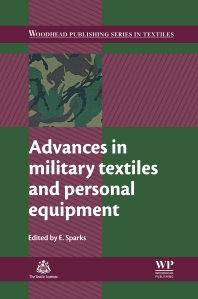
Advances In Military Textiles And Personal Equipment
$19.4
$31.82
Description The right clothing and equipment is of vital importance to the survival and effectiveness of military personnel. Advances in military textiles and personal equipment summarises key research on the design, manufacture and applications of military textiles. Beginning with an overview of design issues, part one explores anthropometric methods, psychological, colour and camouflage issues related to the successful design of military textiles. Materials and design issues in military helmets, footwear and hand wear are also reviewed. Part two goes on to consider applications of particular types of military clothing and equipment, including optimisation of body armour design, high performance ballistic protection using polymer nanocomposite technology as well as advances in materials and modelling of chemical, biological, radiological and nuclear protective clothing. Finally, Advances in military textiles and personal equipment looks specifically at designing load carriage and advanced hydration systems for military personnel.With its distinguished editor and international team of expert contributors, Advances in military textiles and personal equipment is an invaluable resource for all those working in the design, manufacture and production of military clothing and equipment, as well as for the defence industry itself. Key Features Summarises key research on the design, manufacture and applications of military textiles Begins with an overview of the issues related to the successful design of military textiles and reviews materials and design issues in military helmets, footwear and hand wear Sections consider applications of particular types of military clothing and equipment, including optimisation of body armour design, and discusses advances in materials and modelling of chemical, biological, radiological and nuclear protective clothing Readership Military textiles designers and manufacturers; specialists in technical textiles; defense procurement engineers and suppliers. Table of Contents Part I: Design issues in military clothing and equipmentChapter 1: Key issues in body armour: threats, materials and design Abstract: 1.1 Introduction 1.2 Injury mechanisms 1.3 Armour and threat characteristics 1.4 Textile ballistic body armour 1.5 Knife armour 1.6 High-velocity ballistic armour 1.7 Conclusions Chapter 2: Assessing military equipment requirements and capability: the Australian experience Abstract: 2.1 Introduction: history of Australian LAND 125 (L125) soldier modernisation project 2.2 The development of the integrated soldier combat system 2.3 The spiral development action plan (SDAP) – 2004 to 2010 2.4 The spiral development action plan (SDAP) in-depth – survivability and C4I (command, control, communications, computers and intelligence) 2.5 A systems approach – LAND 125 (L125) high level architecture framework 2.6 Future trends – from spiral development to adaptive acquisition 2.7 Conclusions 2.8 Acknowledgements Chapter 3: Anthropometric methods for the successful design of military clothing and equipment Abstract: 3.1 Introduction 3.2 Anthropometric methods 3.3 Development of sizing systems 3.4 Anthropometry of military personnel 3.5 Conclusions Chapter 4: Psychological issues in military uniform design Abstract: 4.1 Introduction: the evolution of military uniforms 4.2 The protective role of the functional military uniform 4.3 Human factors to be considered in the development of military uniforms 4.4 Future trends 4.5 Conclusion 4.6 Sources of further information Chapter 5: Colour and camouflage: design issues in military clothing Abstract: 5.1 Introduction 5.2 Camouflage: colours and patterns 5.3 Human perception 5.4 Perceiving the environment: the human visual system and electronic imagers 5.5 Camouflage design considerations 5.6 Evaluation of colour and camouflage patterns designs 5.7 Future trends 5.8 Conclusions Chapter 6: Materials and design issues for military helmets Abstract: 6.1 Introduction 6.2 History of ballistic helmets 6.3 Head impact mechanics and injury 6.4 Design aspects of ballistic helmets 6.5 Types of materials used for ballistic helmets 6.6 Modelling projectile impact on ballistic helmets 6.7 Manufacturing of ballistic helmets 6.8 Testing of ballistic helmets 6.9 Future trends and conclusions Chapter 7: Design issues in military footwear and handwear Abstract: 7.1 Introduction 7.2 Fit of handwear and footwear 7.3 Physiological maintenance 7.4 Task performance 7.5 Other factors which influence the design of footwear and handwear 7.6 Future trends Part II: Applications to particular types of military clothing and equipment Chapter 8: Customization of a lightweight bullet-proof vest for the female form Abstract: 8.1 Introduction 8.2 Hierarchy modelling for pattern design of a soft ballistic panel 8.3 Types of fibrous materials used for soft ballistic body armour protection 8.4 Ballistic results from a 3D body armour prototype 8.5 Conclusions Chapter 9: Optimisation of body armour design parameters: vulnerability and survivability assessment Abstract: 9.1 Introduction 9.2 Components of personal armour design 9.3 A systems approach to personal armour design 9.4 Future opportunities to improve personal armour design 9.5 Conclusions Chapter 10: High-performance ballistic protection using polymer nanocomposites Abstract: 10.1 Introduction 10.2 Bullet-proof vests as ballistic protection 10.3 The application of nanotechnology for ballistic protection materials 10.4 Production of high-performance ballistic-proof fibers from nanotechnology 10.5 Applications of nanocomposite ballistic materials 10.6 Future trends Chapter 11: Modelling the comfort and protection qualities of chemical, biological, radiological and nuclear (CBRN) protective clothing Abstract: 11.1 Introduction 11.2 Processes to be modelled 11.3 Micro-scale modelling 11.4 Meso-scale modelling 11.5 Macro-scale full-scale virtual mannequin modelling 11.6 Future trends and conclusions Chapter 12: Advances in materials for chemical, biological, radiological and nuclear (CBRN) protective clothing Abstract: 12.1 Introduction 12.2 Characteristics of chemical, biological and nuclear agents 12.3 Detection of chemical, biological and nuclear (CBN) agents 12.4 Protection from chemical, biological and nuclear (CBN) agents 12.5 Decontamination of chemical, biological and nuclear (CBN) agents 12.6 Multifunctional materials for protection 12.7 Applications of nanotechnology in the defense sector 12.8 Conclusions Chapter 13: Designing load carriage systems for military personnel Abstract: 13.1 Introduction 13.2 Basic principles and key issues of soldier load carriage 13.3 Implications of human factors on soldier load carriage design 13.4 Applications of load carriage systems 13.5 Future trends Chapter 14: Advanced hydration systems for soldiers: the example of the US Army Abstract: 14.1 Introduction: combat hydration requirements 14.2 Historical review of US military hydration systems 14.3 Recent advances in hydration systems 14.4 Future trends for individual hydration Index