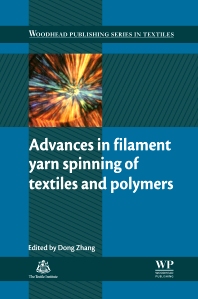
Advances in Filament Yarn Spinning of Textiles and Polymers
$32.49
$49.38
Description Advances in Filament Yarn Spinning of Textiles and Polymers reviews the different types of spinning techniques for synthetic polymer-based fibers, and issues such as their effect on fiber properties, including melt, dry, wet, and gel spinning. Synthetic polymer-based fibers are used in a great variety of consumer and industrial textile applications ranging from clothing to home furnishings to surgical procedures. This book explores how a wide array of spinning techniques can be applied in the textile industry. Part one considers the fundamental structure and properties of fibers that determine their behavior during spinning. The book then discusses developments in technologies for manufacturing synthetic polymer films to produce different fibers with specialized properties. Part two focuses on spinning techniques, including the benefits and limitations of melt spinning and the use of gel spinning to produce high-strength and high-elastic fibers. These chapters focus specifically on developments in bi-component, bi-constituent, and electro-spinning, in particular the fabrication of nanocomposite fibers. The final chapters review integrated composite spinning of yarns and the principles of wet and dry spinning. This collection is an important reference for a wide range of industrial textile technologists, including spinners, fabric and garment manufacturers, and students of textile technology. It is also of great interest for polymer scientists. Key Features Reviews the different spinning techniques and issues such as their effect on fiber properties, including melt, dry, wet, and gel spinning Considers the fundamental structure and properties of fibers that determine their behavior during spinning Reviews integrated composite spinning of yarns and the principles of wet and dry spinning Readership Industrial textile technologists, including spinners, fabric and garment manufacturers and students of textile technology Table of Contents Part I: General issues1. Synthetic polymer fibers and their processing requirements Abstract: 1.1 Introduction 1.2 Chemistry of fiber-forming polymers 1.3 Polymerization processes 1.4 Influence of chemical structure on the physical properties of chemicals and fibers 1.5 Effects of molecular weight on fiber spinnability, structure and properties 1.6 Flow properties of polymers 1.7 Principles of solidification during fiber formation 1.8 Fiber formation techniques 1.9 Post-fiber formation treatments 1.10 Current trends 1.11 Conclusion 1.12 References 2. Understanding the behaviour of synthetic polymer fibres during spinning Abstract: 2.1 Introduction 2.2 Molten state rheology of thermoplastic polymers 2.3 Polymer behaviour during cooling and resulting fibre structure 2.4 Polymer behaviour during filament spinning 2.5 The die swell phenomenon 2.6 Drawing of polymers: changes in morphology and properties of filaments 2.7 References 3. Technologies for the manufacture of synthetic polymer fibers Abstract: 3.1 Introduction 3.2 Textile filament and bulk continuous fiber (BCF) spinning 3.3 Staple fiber spinning 3.4 Industrial fiber spinning equipment 3.5 Monofilament fiber equipment 3.6 Bicomponent fiber equipment 3.7 Spunbond lines 3.8 Melt blown processes 3.9 Solvent spinning lines 3.10 Hollow fiber membranes 3.11 Gel spinning 3.12 Nano-fiber spinning 3.13 Conclusion 3.14 References Part II: Spinning techniques 4. Melt spinning of synthetic polymeric filaments Abstract: 4.1 Introduction 4.2 Fundamentals of melt spinning 4.3 Modeling of polymer flows in melt spinning 4.4 Filament interaction with the environment in melt spinning 4.5 Limitations of melt spinning 4.6 Developments in melt spinning 4.7 Future trends 4.8 Conclusion 4.9 Sources of further information and advice 4.10 References 5. Gel spinning of synthetic polymer fibres Abstract: 5.1 Introduction 5.2 Factors affecting the spinning of polymers: entanglement 5.3 Factors affecting fibre strength 5.4 Gel spinning technologies 5.5 Types of fibres produced using gel spinning 5.6 Factors affecting gel spinning 5.7 Gel spun textile products 5.8 Conclusion and future trends 5.9 References 6. Bi-component and bi-constituent spinning of synthetic polymer fibres Abstract: 6.1 Introduction 6.2 Classification of bi-component fibres 6.3 Spinning technologies 6.4 Factors affecting bi-component and bi-constituent spinning 6.5 Applications of bi-component fibres 6.6 Future trends 6.7 References 7. Electrospinning, processing and characterization of polymer-based nano-composite fibers Abstract: 7.1 Introduction 7.2 Principles of electrospinning 7.3 Electrospinning technology 7.4 Electrospinning of nanofibers 7.5 Properties of electrospun nanofibers 7.6 Conclusion 7.7 References 8. Integrated composite spinning (ICS) Abstract: 8.1 Introduction 8.2 The background and history of integrated composite spinning (ICS) 8.3 The development of ICS technology 8.4 The impact of material selection and processing parameters on ICS yarn properties 8.5 Commercialization of the process 8.6 Assessing the advantages and disadvantages of ICS technology 8.7 Future trends 8.8 Conclusion 8.9 References 9. Wet spinning of synthetic polymer fibers Abstract: 9.1 Introduction 9.2 Principles of wet spinning 9.3 Types of fibers used 9.4 Fiber properties 9.5 Factors affecting wet spinning 9.6 Applications and future trends 9.7 References 10. Dry spinning of synthetic polymer fibers Abstract: 10.1 Introduction 10.2 The dry spinning process 10.3 Characteristics of dry spun fibers 10.4 Variables in dry spinning 10.5 Dry spinning of acrylic fibers 10.6 Dry spinning of cellulose acetate and triacetate 10.7 Dry spinning of other fibers: polybenzimidazole (PBI), spandex and polyvinyl chloride (PVC) 10.8 Conclusion and future trends 10.9 References Index