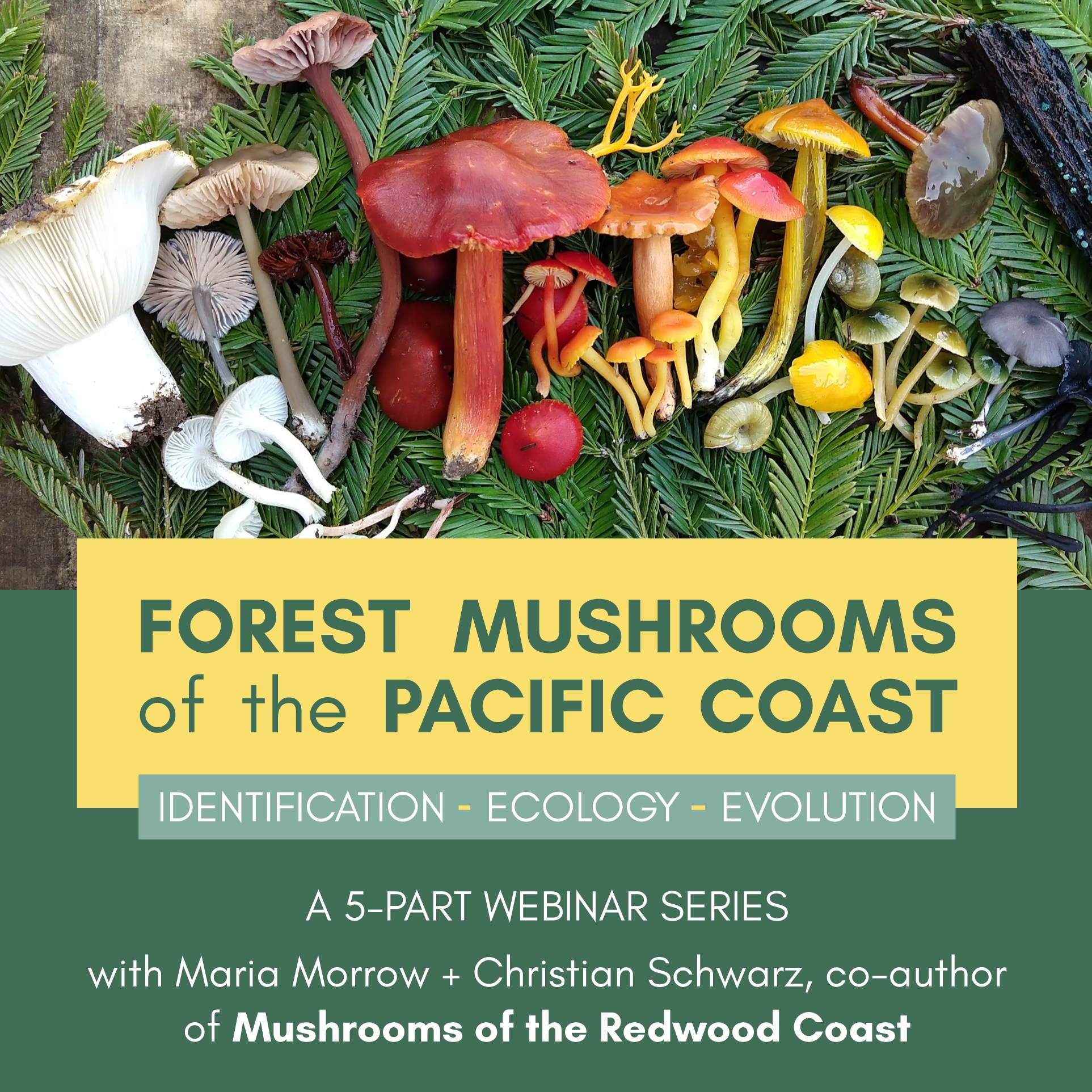
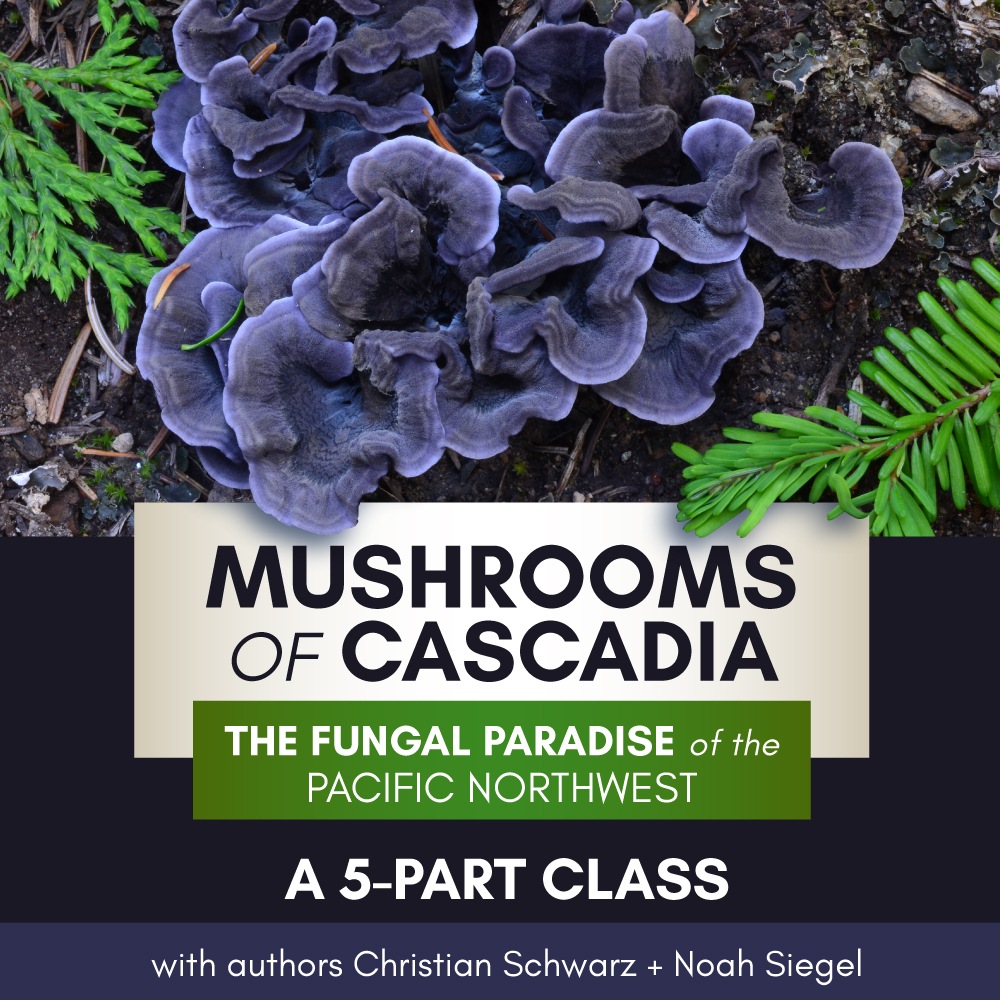
Description Join Maria Morrow and Christian Schwarz for a comprehensive introduction to the forest mushrooms of California and the Pacific Northwest! Over the course of this series we cover foundational topics ranging from the fundamentals of mushroom identification to basic fungal biology. We also discuss the fascinating complexities of the bigger picture: Patterns of ecology, evolution, and biogeography. The series closes with community-science challenges to participate in over the course of the upcoming years! Part 1: Welcome to the World of Mushrooms In our first session we’ll unfurl our mental sails to the wind, catching up quickly on the fundamentals of the fungal lifestyle, and taking a brisk survey of the enormous diversity of this branch of the tree of life. This foundation will allow us a deeper understanding and appreciation for the subtle intertwinings of morphology, ecology, and evolution that we discuss later on. Our journey begins! Part 2: Mushroom Ecology along the Pacific Coast From decomposing individual spruce needles to facilitating complex communications between unrelated forest trees at landscape scale, fungi have a hand in practically every interaction in terrestrial ecosystems. This class will highlight some of the weird, wild, and fascinating ways fungi participate in the structure and maintenance of forest ecosystems. We’ll end by taking a tour through each of the most important mushroom habitats on the Pacific Coast. Part 3: Forest Pathogens of the Pacific Coast Fungi play many roles in forest ecosystems, and one of the most important of these roles is as pathogens. While some of these fungi can have devastating impacts, many native pathogens provide unique habitat, increase biodiversity, and contribute to healthy forest dynamics. This section will explore different types of forest pathogens in Pacific forests, highlight signs and symptoms we can use to identify them, and discuss their roles in maintaining ecosystem function. Part 4: Mushroom Explorations The habitats along the Pacific coast support a unique and astoundingly rich assemblage of mushrooms. During this session, we’ll start by learning general principles of mushroom identification, including basic anatomy and vocabulary; as our recognition skills grow and we gain footholds in the vast diversity of fungi, we’ll end by taking a close look at some of the individual species and remarkable groups of fungi that make the western forests such a treasure. Part 5: Gaps in our understanding / Future Directions / Threats and Changes in the coming decades It’s no secret that our world is changing rapidly and turbulently. We may lose a great deal of the biodiversity that surrounds us due to the twin threats of habitat destruction and climate change, and fungi are no exception. In our last session, we’ll discuss what can be done to fill in the gaps in our understanding of our fungal neighbors, and strategize ways to engage our communities in working to ensure a continued existence of these astonishing organisms. Your Teachers Maria Morrow Maria Morrow is a professor of botany and environmental science at College of the Redwoods in Eureka, California. She grew up in the wonderfully damp city of Seattle and somehow managed to learn nothing about fungi until she moved to California in 2012 and took Terry Henkel’s Forest Pathology course at HSU. Since then, she has been digging in the duff, looking at logs, and even prodding at poop to get a better understanding of this mysterious kingdom of life. She studied fungal genetics and forest pathology at U.C. Berkeley and is currently working with the Humboldt Bay Mycological Society to survey the macrofungi of Redwood National Park. You can find her on iNaturalist as YipKiyay or every third Wednesday of the month on Zoom with HBMS. Christian Schwarz Christian Schwarz studied Ecology and Evolution at UC Santa Cruz, where his interest in the world of fungi became irrevocable – their seemingly endless forms (from the grotesque to the bizarre to the sublime) feed his curiosity. Christian now teaches Natural History of Fungi to undergraduates, and is a research associate of the Norris Center at UCSC. He is co-author of Mushrooms of the Redwood Coast, and now spends his time seeking, photographing, collecting, teaching about, and publishing research on the macrofungi of California and Arizona. He is a research associate of the Santa Barbara Botanic Garden, and is assembling a mycoflora for the California Channel Islands. He has also served on the IUCN Red List Working Group for North American Fungi, advocating for habitat conservation focused on fungi. He is passionate about biodiversity in general, and especially in the philosophy and practice of community science (especially through the use of iNaturalist). You can find his blog at www.Biodiversiphile.com